Business Model Canvas
Strategy for launching the digital ecosystem.
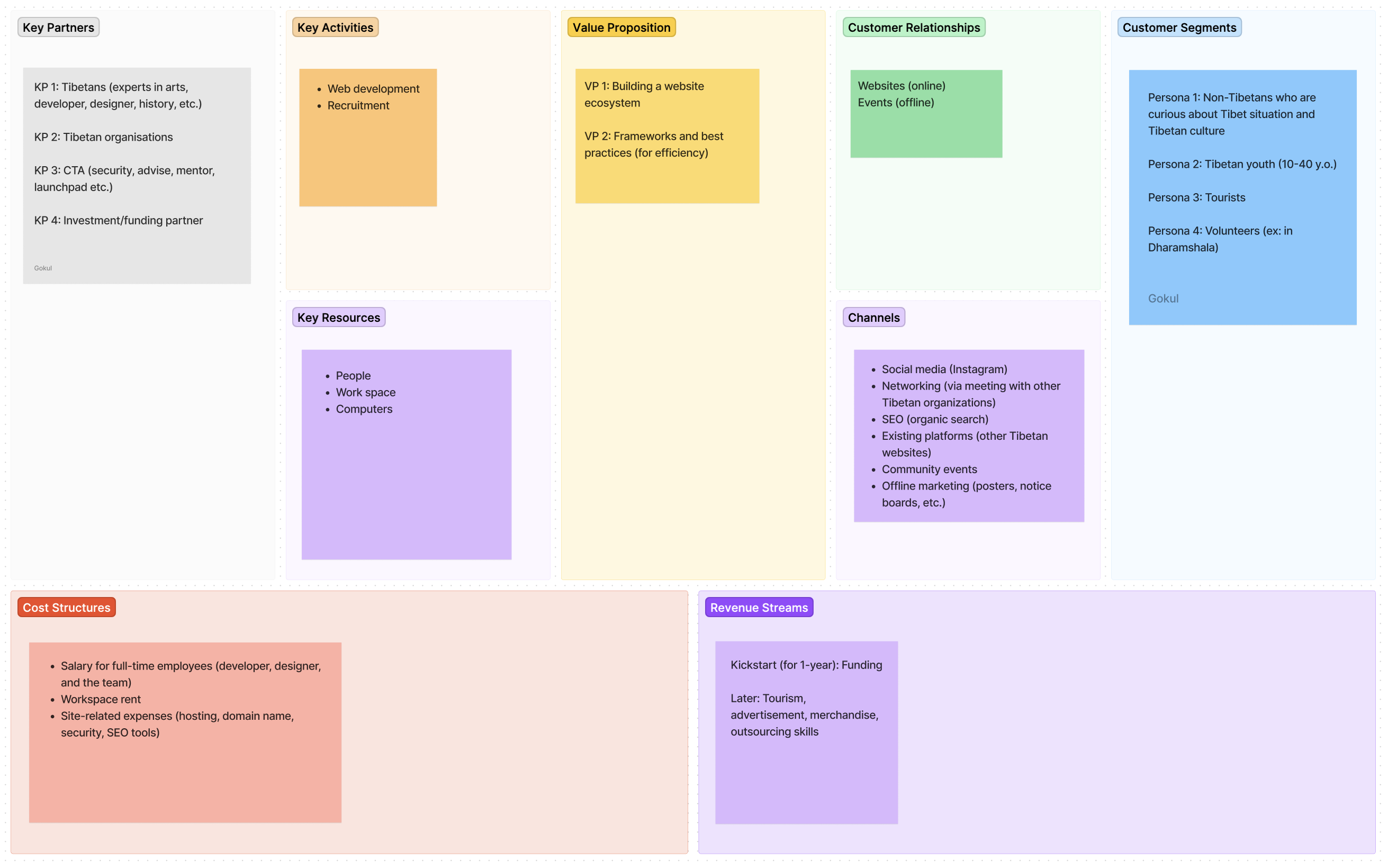
| Segment | Driving Questions | Segment Description |
|---|---|---|
| Value Propositions | What problem are we solving? Why does it need to be solved? | VP1: Build a website ecosystem. VP2: Establish frameworks and best practices for efficiency. Refer to problem statement sheet |
| Customer Segments | Who are we solving the problem for? Who will value the proposition? What are their characteristics? | Persona 1: Non-Tibetans curious about the Tibetan situation and culture. Persona 2: Tibetan youth (10–40 y.o., diaspora). Persona 3: Tourists. Persona 4: Volunteers (e.g., in Dharamshala). Other: Tibetan artists, business owners, Free Tibet orgs, monasteries (4 sub-segments) |
| Customer Relationships | What is our interaction with customers like? | Online: Websites. Offline: Events |
| Channels | How do customers come in contact with the product? How do we communicate the value proposition? Where are the customers? | Social media (Instagram), Networking with Tibetan orgs, SEO (organic search), Existing platforms (Tibetan websites), Community events, Offline marketing (posters, boards), Word of mouth |
| Key Activities | What activities must the business undertake to achieve the value proposition? How is the product distributed? | Web development, Recruitment |
| Key Resources | What practical resources are needed for the key activities? | People, Workspaces, Computers |
| Key Partners | Who are our key partners? Why do we need them? | KP1: Tibetan experts (art, dev, design, history). KP2: Tibetan organisations. KP3: CTA (security, mentorship, advisory). KP4: Investors/funding partners |
| Cost Structure ($) | What are the monetary costs of operating? What costs are tied to activities, partners, and resources? Legal, insurance, etc? | Salaries for full-time dev/designer/team, Workspace rent, Hosting, domain, security, SEO tools, Slack, ClickUp, GitHub |
| Revenue Streams ($) | How do we convert our value proposition into financial gain? | Year 1: Funding (possibly via Kickstarter). Later: Tourism partnerships, ads, merchandise, skill outsourcing |